Its own pile
Ready for AI answers sits beside Do these first and Helps on Google in Page problems.
AI answers quote pages that answer a question plainly. WPCentrify checks every page of every website you manage and shows which ones Google's AI Overviews, ChatGPT and Perplexity can quote easily, and what to change on the rest.
Included on Studio and up, or a $15 add-on on Solo. Uses no AI credits.
Updated
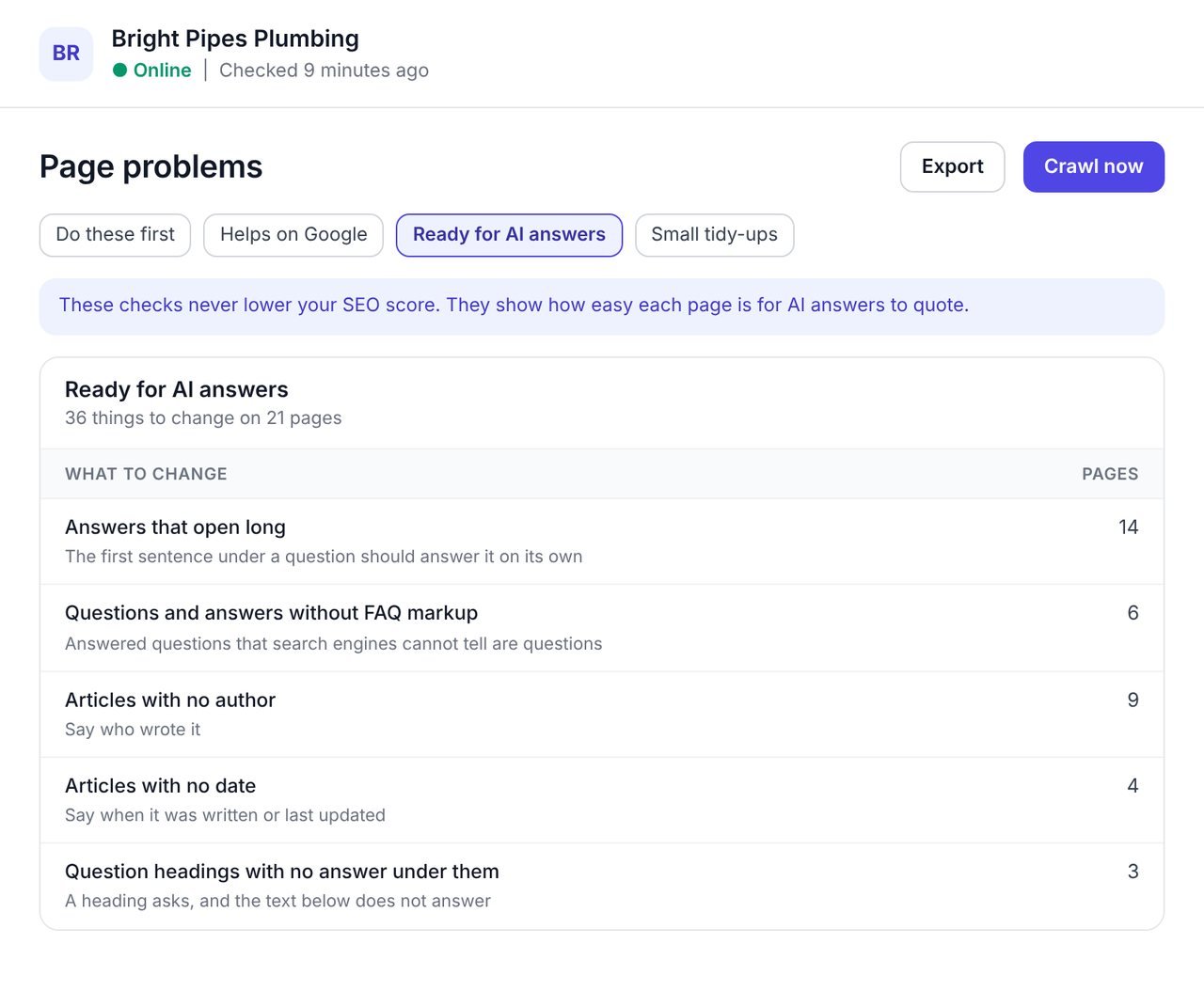
An AEO audit checks your pages for the things that make them easy for AI answers to quote: questions as headings, a short direct answer under each, clear questions and answers, a named author and a date. AEO stands for answer engine optimization. You will also see it called GEO, generative engine optimization, or AI search optimization.
Most websites were written for a different kind of search, and nobody can tell which of their pages an AI assistant would pick up. WPCentrify works it out from its regular check of every page, so each page says what is missing and how to fix it, in plain words a client can read.
It sits in Page problems as its own pile, Ready for AI answers. None of it is an error, so it never lowers your SEO score or counts as a warning in reports.
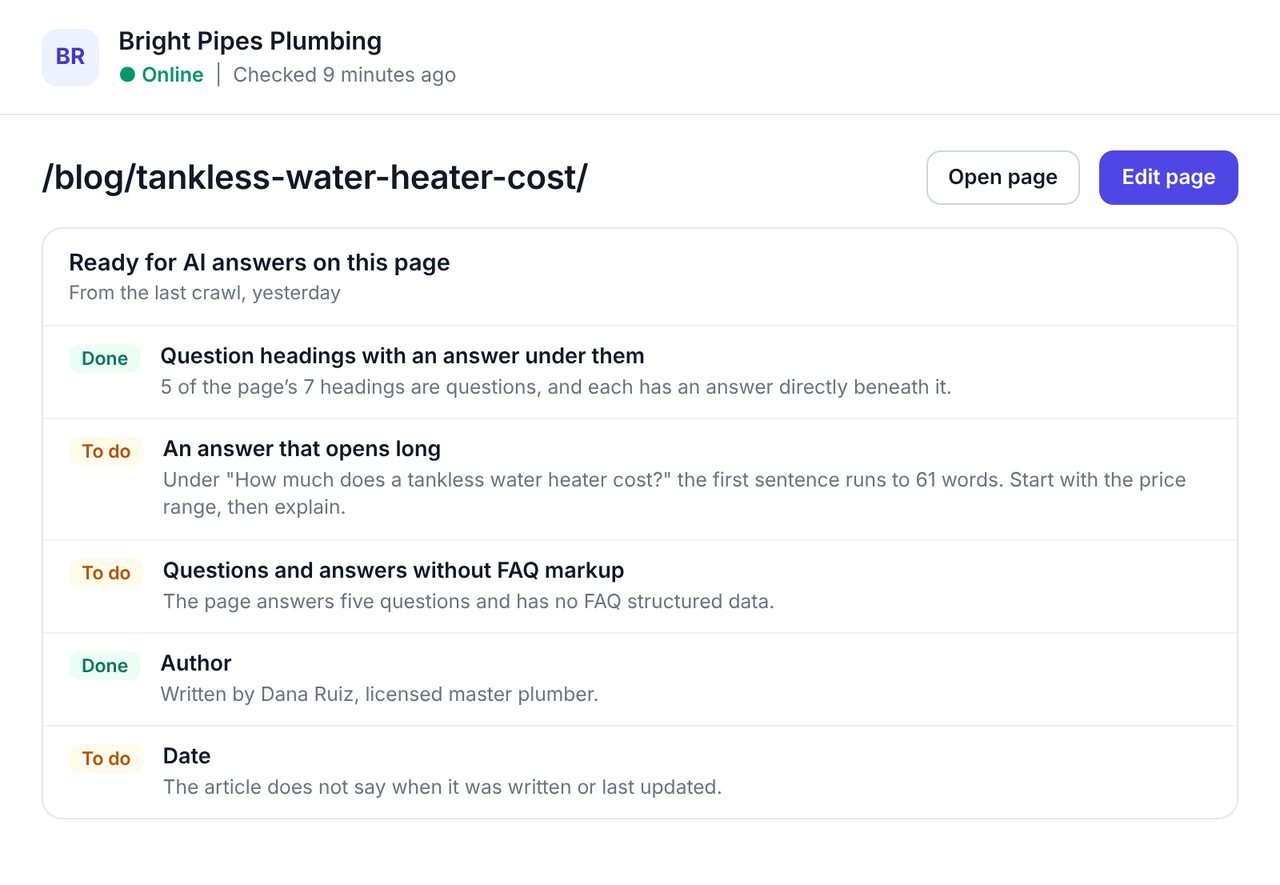
Open any page to see what it already does well for AI answers and what to change, most useful first.
A blog post might have five question headings, each answered, a named author, and still no date. The report says so, with the heading and the sentence in question, so the fix takes minutes rather than an afternoon of reading.
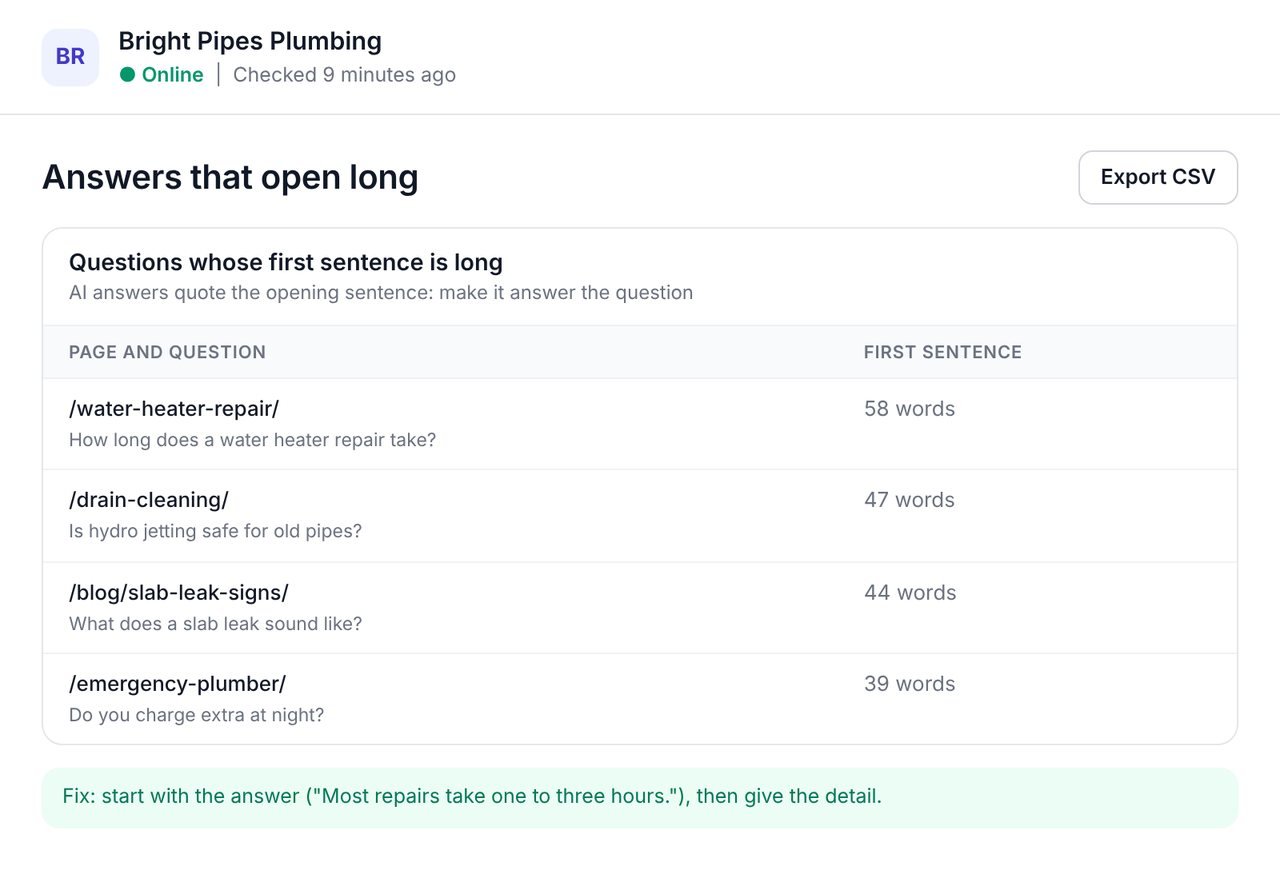
AI answers tend to quote the opening sentence under a question, so that sentence should answer the question on its own.
WPCentrify lists the questions on your pages whose first sentence runs long, with the page, so a writer can rewrite the opening line: the answer first, the detail after.
Most AEO checkers read one page at a time. This reads every page of every website you manage.
Ready for AI answers sits beside Do these first and Helps on Google in Page problems.
None of these is an error, so your SEO score and reports are untouched.
Each page says what is missing and how to fix it.
A page read before these checks existed is not judged on them.
The same filters, sorting and exports as every Page problems list.
A CSV and a PDF report under your brand with White label.
Five checks, each tied to how AI answers pick what to quote.
| Check | What it looks for | What to do |
|---|---|---|
| Question headings with an answer under them | How many headings are questions, and whether each has an answer directly beneath it. | Answer each question in the paragraph straight under its heading. |
| Answers that open long | A question whose first sentence under it is long. | Start with the answer in one short sentence, then explain. |
| Questions and answers without FAQ markup | A page with several answered questions and no FAQ structured data. | Add FAQ structured data that matches the questions on the page. |
| Articles with no author | An article that does not say who wrote it. | Show the author's name, and link to a page about them. |
| Articles with no date | An article that does not say when it was written or last updated. | Show the date it was published or last updated. |
Connect the website to WPCentrify. The audit uses the regular check of the website, so there is nothing to install on it.
Go to SEO, Page problems, and choose the Ready for AI answers pile.
Sort by page and open the service pages and articles people reach most.
Rewrite answers that open long so the first sentence answers the question.
Add FAQ markup where questions are answered, and an author and a date to articles.
The next check of the website shows the pile shrink.
Google says there are no special requirements to appear in its AI features and no new files or markup to add; a page must be indexed and eligible to show with a snippet. The pages AI answers quote still have a shape in common, and it is good writing for people too.
Then measure the result: the AI Overview tracker shows Google's AI answers for your keywords, and AI brand visibility shows whether ChatGPT, Claude, Gemini and Perplexity name you.
What people ask before they turn it on.
An AEO audit checks your pages for the things that make them easy for AI answers to quote: questions as headings, a direct answer under each, FAQ markup where questions are answered, a named author and a date. WPCentrify runs it on every page of every website you manage.
SEO is about ranking in search results. AEO, answer engine optimization, is about being quoted in AI answers such as Google AI Overviews, ChatGPT and Perplexity. Most of what helps one helps the other, and the AEO audit sits beside the SEO audit in WPCentrify.
They are close. GEO, generative engine optimization, is another name for making content easy for AI systems to use in their answers. The checks in an AEO audit serve both.
No. Its findings sit in their own pile, Ready for AI answers, and never lower the SEO score or count as warnings in reports.
Nobody can promise that. The audit makes pages easier to quote; whether an assistant quotes them also depends on what else it can find. AI brand visibility shows what the assistants actually say.
Google says you do not need new machine readable files, AI text files or markup to appear in its AI features. The audit focuses on the page itself: clear questions, direct answers, authors and dates.
The site structure checks flag a robots.txt that refuses the agents that answer people, which is different from refusing the crawlers that collect training data.
No. Everything is read from the regular check WPCentrify already runs, and nothing is added to the website.
No. The AEO audit is part of the SEO toolkit and uses no AI credits.
Connect a site and open Ready for AI answers. The first fixes take minutes.
Plan prices to be revealed. Keep your data, export any time.